Showing posts with label question. Show all posts

Automatic Fuel Pricing Mechanism

You can find plenty of debate on the web about the fuel pricing mechanism in Malaysia.

Some goes to the extent of accusation, nevertheless, the industry people know what is true n what is false. What they don't tell you is the human interference in the decision.

The number will be churn out as at decision date, was never wrong. This breakdown is correct. That Alpha is the unfair advantage that should be retrieve from the fuel distributors. Why? Go find out what is its basis.

ekkamai-simplelife
Kredit: paultan.org   

There is one instance in our history, the spike is too much, that decision kill a character. I still remember that day. 78 sen per litre spike!

ekkamai-simplelife
Kredit: malaysiakini.com


If current crude oil price around USD50/bbl translate to RON95 price of around RM2.10, do you think the price of RM2.70/litre is fair when the crude price hovers around USD150/bbl? Go calculate for your satisfaction. It is definitely, an ill advise at work at that time. 


ekkamai-simplelife
Kredit: macrotrends.net

Merdeka???


Owe the bank housing loan till you die...


Do you really know how your housing loan is calculated? I bet the general public will answer "NO" to this question. Thanks to HBA which highlights this unfair housing loan agreement, which will make us owe the bank housing loan till you die. 

housing-loan

MOST if not all house buyers will require financing to buy their dream homes. While there appears to be stiff competition among banks for market share and interest rates may be kept low, house buyers are ultimately at the mercy of banks when it comes to the detailed terms and conditions of the housing loan. (Banks in this context refers to commercial banks, Islamic banks and other financial institutions).

Unfair legal fees
When a borrower takes a housing loan, the borrower is required to execute a loan and other related agreements. This entails the borrower having to pay legal fees, the amount of which varies, depending on the loan amount – the higher the loan amount, the higher the legal fees although the complicity and level of work does not necessarily commensurate directly with the loan amount.

Although it is the borrower paying the loan lawyers’ fees, the said loan lawyer is actually acting for and on behalf of the bank. As such, the loan lawyer is not in the best position to advise the borrower if there are clauses in the loan agreement which are not in the best interest of the borrower.

In addition, in the event of any dispute between the borrower and the bank, the borrower cannot ask the loan lawyer for advice as the loan lawyer is acting for the banks.

If this is the case, then is it “fair or equitable” for the borrower to pay such legal fees when it is clear that the lawyer is actually acting for the banks? Obviously not. Hence, the bank should absorb the legal fees as the lawyers are clearly there to act for the bank and protect its interest.

Exorbitant fees for simple letters
The banking sector in Malaysia is a very tightly regulated industry. Any fees that banks intend to charge must be approved by Bank Negara. It is disheartening to note that borrowers continue to be charged exorbitant fees which seem to have the explicit blessings and consent of Bank Negara. Instances of borrowers being charged unreasonable fees for copies of redemption statement, EPF statement letter etc are common.

Allocation of monthly repayment to principal and interest
This is a story about three friends who took a housing loan (HL) of RM500,000 ten years ago. They were offered the same HL interest rate of 4.2% (base lending rate of 6.60% less 2.40%) but took different loan tenures as follows:

Albert took a 20-year HL. Eric took a 25-year HL and Jamie took a 30-year HL.

After servicing their monthly loan installments diligently for the past 10 years, they decided to fully settle their housing loan using a combination of their EPF monies and own savings. When they asked for a redemption statement to find out what was the principal sum outstanding, they received a shock of their lives.

Albert, Eric and Jamie were under the impression as they had served 50%, 40% and 33.3% of the loan tenure, their principal sum outstanding would be RM250,000, RM300,0000 and RM333,333 respectively.

So, when their respective redemption statement showed that Albert, Eric and Jamie still owed respectively RM301,654, RM359,415 and RM396,652, they got a big shock.

So, why did they still owe so much more than what they had thought? The answer lies in the allocation of the monthly installment towards covering the principal sum and interest charged by the bank.

In an equitable world, the monthly installments would be allocated on a “straight line basis” to cover the principle and interest charged. Thus, a borrower who served 10 out of a 20-year HL would only owe 50% of the original loan amount.

However, the reality is that the borrower still owes 60.3% of the original loan amount.

The typical borrower will always be “penalised” for settling his loan before the maturity date. Even in the penultimate year of the original loan tenure, the actual amount outstanding is still higher than the theoretical amount, which should be the amount outstanding had the allocation of monthly installments been done on a straight line basis.

Is it fair and equitable?
Most borrowers do not know or even understand how this allocation is calculated. Is such an allocation “fair and equitable” to the borrower? Under such circumstances, are borrowers supposed to accept that the bank’s own generated computer system has calculated the interest correctly and allocated the payments in the correct manner?

To the borrower, they have paid 10 out of a 20-year loan, he should only owe balance 50% and not 60.3%. Is this manner of allocation not just another unjust way for the bank to generate higher profits, after all the bank did receive the payments on time and in full every month. It is the dream of every borrower to be debt-free as soon as possible and it is not fair to the borrower to be penalised in such a manner when he wants to settle his loan early.

That said, borrowers have no choice but to accept the calculation of the bank as correct and final. If the borrower were to reject and not pay the required sum, the loan will not be considered as repaid in full. The borrower could even be blacklisted and even have his property auctioned off by the bank to recover the remaining sum outstanding if the borrower refuses to pay up.

It would be more transparent and equitable if the monthly payments made by the borrower are allocated in a “straight line basis” to interest and principal equally over the

tenure of the housing loan. Short of that, borrowers are at the mercy of banks.

Some banks operate like a “cartel” and standardise their fees to be charged to customers. One wonder whether such unfair practices are condoned by the regulators like Bank Negara.

It is also interesting to note that banks are exempted by the Malaysia Competition Commission allowing banks to agree and collude on unfair fees, penalties and practices to be charged to borrowers.

Unnecessary expenses
Loan agreement “printing charges” – sold between RM150 and RM350. The banks’ solicitors need to purchase a standard loan agreement from the bank (via soft copy) and adds the borrowers’ details in order to complete the loan agreement. The banks charge the lawyer and the lawyer charges the borrowers.

Standard loan agreements are now downloaded from the bank’s website or from soft copy. The bank no longer need to print them and should not charge for such documents. Alas, this has been continuing till to date.

Lopsided terms and conditions
Lopsided terms and “add-on” products are aplenty, if the borrower wants to identify with them. It would be good practice to remove or qualify the banks’ arbitrary powers.


Conclusion
The National House Buyers Association (HBA) had on Sept 4, 2014 made representation to the Finance Ministry (MOF), Bank Negara. Housing and Local Government Ministry in the presence of Association of Banks Malaysia and Islamic Banks of Malaysia in the form of slides presentation on some observations and unethical practices of some banks.

HBA is looking to work closely with MOF, Bank Negar and all related stakeholders to level the playing field for housing loan borrowers in the long-term interest of the banking industry. We had proposed to set up a working committee to resolve all unfair practices. MOF and Bank Negara have a legitimate interest in the final shape of the banking industry into operating a principled and towards a “customer friendly arena”.


Article from thestar to assist homebuyer by:
Chang Kim Loong is the honorary secretary-general of the national House Buyers Association: www.hba.org.my, a non-profit, non-governmental organisation manned purely by volunteers.


My final say:
If you think this housing loan is absurd, go and find out about Hire Purchase Act 1966. You'll be blown away.... merdeka from what?

Rumah oh rumah - Aku tak mampu memilikimu

Ketidakmampuan memiliki rumah telah diketahui umum. Namun mereka yang diberikuasa adalah penyamun sebenarnya. Selagi apa yang mereka dapat tersedia depan mata, membutakan mata, memekakan telinga adalah sifat semulajadi mereka, apa mereka mahu revolusi? Walaupun mengetahui kekuatan kerajaan Singapura adalah pada keupayaan menyelesaikan pekara keperluan asas rakyatnya.

Khazanah Research Institute (badan kerajaan ni) melalui repot pada 24 Ogos 2015 mula membuka bicara. Diulang pula oleh Lapuran Bank Negara 2015, namun siapa peduli?

Terusan dicanang harga rumah sekitar RM500K adalah rumah milik. Bangangnya mereka!

 Memang saya marah dengan puak-puak yang menjanjikan langit & bumi setiap 4 tahun nie.


Yang tidak mampu ketika ini, bersedialah dengan 10% deposit untuk rumah idaman anda (buat homework sekarang) kerana rasanya tak lama dah firesale akan kembali.

Tak logik untuk BNM melaung sekuat itu kerana mereka-mereka itu adalah yang terarif dalam hal kewangan!

Untuk yang bersedia, jadikan Rumah oh rumah - Aku mampu memilikimu.


Leakage - Kebocoran di unit strata

Leakage - A strata living nightmare

Salient point:
Stiff penalty: Whoever fails to give access to the party carrying out the inspection commits an offence. The fine imposed is up to RM50,000 or imprisonment of up to three years or both, under regulation 63(2).

IF you live in a high rise building and have an inter-floor leakage issue, you can be rest assured that you are not alone. Inter-floor leakage is without a doubt one of the biggest problems faced by many dwellers of high rise buildings.

Whilst the leakage may appear only in a particular parcel, the source of the leakage may lie in the parcel above or even elsewhere. The cooperation of more than one party is therefore required; without which one cannot even begin to identify the problem, let alone solve it.

Two issues must be identified when there is an inter-floor leakage. Firstly, the source of the leakage and secondly, the person or body responsible for repair or rectification. Who is supposed to identify the source of the leakage to start with? The person or body responsible of course, you may say, but how do you know who is responsible before the cause of the problem is ascertained? A bit of a chicken and egg situation arises.

New Act

Will the new management Act answer to all ceiling leakages?

In February 2013 the Strata Management Act 2013 (SMA) was passed by Parliament. With that came a presumption in law, under Section 142 of the SMA, that if the leakage is on the ceiling, then such leakage is presumed to be from the parcel above unless it is proven otherwise. So, if you have a leakage from your ceiling, go to your upstairs neighbour and tell him/her that he/she is responsible and must therefore find the source of the leakage and do the repair. What if he/she disclaims responsibility? Simple, You just quote Section 142 of the SMA. What a magical section with a “one fits all” answer to ceiling leakages! I thought so too when I first read Section 142, but I was not completely right for the law does not place the entire responsibility squarely on the upstairs parcel owner.

It was to be another couple of years before the SMA was implemented in June 2015 but the good news is that with that came also the implementation of the Strata Management (Maintenance & Management) Regulations 2015 (SMR). Many thanks to those (including HBA volunteers) who worked tirelessly on drafting and fine tuning the provisions of the SMR, we now have some definite answers on what to do if you have a leakage from your ceiling.


Who is responsible?

In dealing with inter-floor leakage one must not just look at Section 142 of the SMA but also Part XV of the SMR. Indeed it is Part XV of the SMR which tells you what to do if you discover dampness, moisture or water penetration from your ceiling or if you were to go home one day only to find that it is raining in your apartment.

Go to the developer if you are still covered by the defects liability provisions.

If the leakage is still covered by the provisions of your sale and purchase agreement (SPA), follow the provisions of your SPA. For homebuyers, these are typically cases where the leakage or defect occurs during the defects liability period, and which the housing developers are required to rectify, as provided in the statutory SPA.

JMB/MC/Management first in the line of responsibility – regulation 56

If the leakage is not one which is covered by the SPA, then notice may be served by the owner of the affected parcel on the developer or the joint management body (“JMB”) or the management corporation (“MC”) or the subsidiary management corporation (“sub-MC”), as the case may be.

This is provided for in regulation 56(1) of the SMR. What regulation 56 essentially means is that you serve notice on the body responsible for the maintenance and management of the common property, which for convenience I shall refer to as “the management”. So, now you see, the party first in the line of responsibility is not your upstairs neighbour but the management.

Once notice is received, the management must, within seven days, carry out an inspection to determine the cause of the leakage and the party responsible for rectification (regulation 57). Thereafter, the management must issue a “Certificate of Inspection” stating the cause of the inter-floor leakage as well as the party responsible for rectification (regulation 59). A standard form certificate for this purpose can be found in Form 28 under the Second Schedule of the SMR.

So, what is the purpose of Section 142, you may ask? Section 142 merely creates a presumption that the defect lies in the parcel above. In practical terms, this does nothing towards resolving any inter-floor leakage issues other than perhaps as a starting point for inspection. After all, one cannot possibly rectify a defect which causes the leakage until and unless the actual defect is identified. The legal implication of Section 142, however, is perhaps best left to those much more qualified than I but I do wonder if this statutory presumption alone can be a valid ground for holding the upstairs parcel owner responsible and if so under what circumstances in light of the provisions of the SMR.

Determining factor(s)

Under regulation 58 of the SMR, the management must take into account not just the aforesaid presumption but also the following matters which to my mind are far more relevant once the defect is identified:-

(1) that any defect in something which serves more than one parcel is a common property defect; and

(2) that any defect in something which serves only one parcel is a defect of that particular parcel even though that something is situated in common property or in void space.

In other words, the determining factor is not the location of that defective something but which parcels that something serves. If it serves just one parcel, that particular parcel owner is primarily responsible and must rectify the defect failing which the management shall carry out the rectification works and charge the expenses to that particular parcel owner. I say primarily because whilst regulation 61 of the SMR imposes the obligation on a specific parcel owner such obligation is expressly stated to be without prejudice to that parcel owner seeking indemnity from someone else.

That of course begs the question of who can be held liable for such indemnity; a question which is beyond the scope of this article but I certainly will not rule out any parcel owner, including the affected parcel owner, who contributes towards the defect or any delay in the rectification of the defect.

The decision of the management is, as expected, not final. Anyone not satisfied with a decision made against him/her may refer to the Commissioner Of Buildings (COB) who shall ascertain the cause of the leakage and the party responsible in accordance with regulation 64(1) & (2) and the decision of the COB shall be complied with by all parties concerned.

Grant access for inspection or risk prosecution

It goes without saying: that neither inspection nor rectification works can be effectively carried out without access to all relevant parcels and common property. Hence, the imposition of a statutory obligation on all relevant parties to give access as provided by regulation 63(1) of the SMR comes as no surprise at all.

Whoever fails to give access to the party carrying out the inspection commits an offence! And the punishment is severe too; a fine of up to RM50,000 or imprisonment of up to three years or both, under regulation 63(2).

Given that the lack of cooperation on the part of some parcel owners/occupiers has remained one of the main causes of delay in resolving inter-floor leakage problems, these provisions are definitely a step in the right direction. It does puzzle me, however, that whilst a failure to give access for inspection tantamount to an offence, the same does not seem to apply to a failure to give access for rectification.

Some of you cynics out there may be tempted to brush this aside as something unlikely to be enforced by the authorities but do you want to take that chance? Do you really want to risk prosecution over something as simple as giving access for inspection and/or rectification?

Beside, now that the Strata Management Tribunal has been set up you may be slapped with an order much sooner than you think.


Chang Kim Loong AMN is the honorary secretary-general of the National House Buyers Association: www.hba.org.my , a non-profit, non-governmental organisation manned purely by volunteers.

Kebocoran di unit strata adalah tanggungjawab siapa?

Artikel berinfomasi dari thestar.com.my!

Drive or take the public transport?

Are you among five million people who get stuck in the Klang Valley traffic every day?

According to the World Bank’s 2015 Malaysia’s Economic Monitor report:

  • Jams in Greater Kuala Lumpur may be getting bigger;
  • Commuters wasted between 270 and 500 million man-hours in the Greater KL jams last year.
  • Cars used a possible 1.2 billion litres of fuel idling in traffic;
  • Lost hours and fuel for each person in Greater KL came to at least RM3,100 each year, more than the monthly local average salary (RM2,795); and
  • Total cost of traffic in Greater KL is estimated at 1.1% to 2.2% of GDP in 2014.

“This is a tangible economic cost, in the sense that this is equivalent to money that could otherwise be in the pockets of the people of Kuala Lumpur,” - Luis C. Blancas, World Bank senior transport specialist.

World Bank data now suggest they may have to spend a longer time on the road.

Transport costs here are also high, accounting for nearly 10% of all monthly household expenses. Much of this can be saved if people took public transport. Really? Lets see.

I use this journey as an example.

Travelling via LRT from Bukit Jalil to Hang Tuah station in the city used to cost RM1.90 before but now..... (sourced from: http://www.myrapid.com.my/jp/index.php)

One way LRT fare 

Wow that is RM1.30 (cashless, ie via rapidcard or T&Go card) more or a whopping 68% increase!

If two friends were to traveled to say Bukit Bintang n back, that is going to cost them RM12.80 for the total fare using the LRT.

Say they drive there, spend few hours and back. The return estimated distance is 29km.

One way driving distance
  
How much it gonna cost them for that distance? If they use a common car which has an average fuel consumption of 8litre/100km, That is 2.32 litres and if petrol cost RM1.90/litre, the fuel cost is RM4.41 only.

Yeah, the are other cost like car cost, route and toll charges, parking fee, travelling time, etc but those are variables which depends on individual preference. 

I bet most of us did not realised that current LRT fares are now unique (different price) from a station to station, not like before which adopt sector concept where a same fare for few station within specified sector of stations. 
It means that before, RM1.90 was the fare to disembark at any stations from Hang Tuah up to PWTC, not any more.

The flaw in the new LRT fare?  Source.

To Station: Hang Tuah-PlazaRakyat-Masjid Jamek
RM: 3.20 - 3.30 - 3.40

To Station: Bandaraya-Sultan Ismail-PWTC
RM: 3.10  - 3.20  -3.30  

What is the rationale here? What comes to mind is, profit maximisation or cross subsidy?

So there you have it. Decide for yourself if the statement "people save if they took public transport" applies now days. It was before, for me.


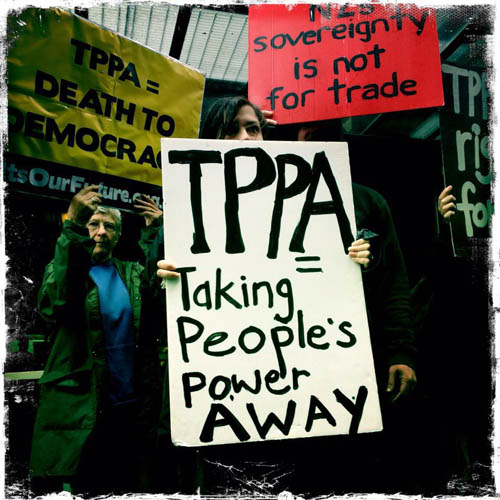
Dear Politician, Does Malaysia really need TPPA?


I've share the post about A matter of life and death, an article that get me interested in the TPP in the first place. This issue is not making life simpler but indeed going to make it harder. These are snippets of information dig out from various sources.

I've made up my mind about this issue and you had a chance to read through links below and decide.


View#1
"That (TPPA) is not a trade deal, it is an investment deal," said Dr Jomo Kwame Sundaram, who is also assistant secretary-general of economic development in the United Nations' Department of Economic and Social Affairs (DESA).

"Malaysia gets next to nothing. I was extremely disappointed and I think it is going to affect not only the Malaysian business community, but also the consumers and citizens adversely," he told reporters on the sidelines of the Khazanah Megatrend Forum 2015 today.

He said the agreement is mainly driven by "political considerations" for the US to isolate China.

"Hence, it (TPPA) is not really to help Malaysia, and (the) trade advantages are very minimal," he added.

Jomo cited Malaysia, which has been producing solar panels, being prohibited to sell the solar panels in the US and elsewhere under the pact.

"This is contravening the multi-lateral trade agreements and I do not expect the TPPA to overcome this," he said.

According to Jomo, the main impact of the TPPA would be the increasing cost of intellectual property, which will have many implications on electronics and cost of medication.

"We can wipe out many diseases in the world, but the people who control the drugs are depriving people of the world from benefitting it," he said.


View#2
What was promised to us is a Parliamentary debate, not approval. Under Malaysian law, trade agreements, the TPPA in particular, do not require parliamentary approval. The power to decide rests on the Executive.

5. This is a done deal. No country has ever walked out of an agreement after negotiations have concluded.

9. The release of a Cost Benefit Analysis (CBA) or National Interest Analysis had been promised and postponed since end of last year to every consecutive month since May 2015 to date. Until now, it has not been released and we only have three (3) months from the official date of negotiation’s conclusion to the date that it has to be signed. The CBA, if finalised and released earlier, would have provided the public and interested parties with a greater understanding of the TPP and its implications.


View#3
“If instituted, the TPP’s IP regime would trample over individual rights and free expression, as well as ride roughshod over the intellectual and creative commons,” Assange said. “If you read, write, publish, think, listen, dance, sing or invent; if you farm or consume food; if you’re ill now or might one day be ill, the TPP has you in its crosshairs.”

“No wonder they kept it secret. What a malicious piece of US corporate lobbying. TPP is about world domination for US corporations. Nothing else. We will stop this madness in New Zealand,” he told RT’s Andrew Blake.


View#4
If you still haven’t made up your mind, read the chilling “The Trans-Pacific Partnership and the Death of the Republic” by Ellen Brown of the Public Banking Institute. Is it all hyperbole, or could things be as ominous as they seem?

The TPP, which involves 12 nations and 40% of the earth’s trade, has been called “NAFTA on steroids.” (NAFTA, recall, was the North Atlantic Free Trade Agreement of 1993 negotiated during the Clinton Presidency). Every such agreement has been sold to the public by the promise that free trade floats all boats. What’s the reality? According to Buchanan, “… almost all [the big trade agreements] have led to soaring trade deficits and jobs lost to the nations with whom we signed the agreements.” Over the past four decades of free trade, America, cites Buchanan, has lost 55,000 factories and 5-6 million manufacturing jobs, all while racking up $11 trillion dollars in trade deficits.


View#5
Trans-Pacific Partnership Free Trade Agreement Permits Corporations To Sue States
Leaked TPP investment chapter: Corporations can sue states in private courts


View#6
Malaysia will lose RM75billion & the government can be sued - Listen to podcast.


So my question to beloved politician, does Malaysia really need TPPA? Think hard rather than aye sir!


photo credit - bilaterals.org

A matter of life and death

Although this article is more than a year old, learning the subject from the view of industry players, I must say that Malaysia government is truly negotiating something which may put us in a difficult situation. Friends living abroad such as in India or Thailand knows and to their amazement that price of generic drug are damn cheap there! And these countries could not be bothered about anything to do with drug because they simply know that any such agreement will make them suffer, so why bother. Malaysia's bio diversity offers us lots of avenue but I'm confused why we need to agree to such flexing agreement. Please read Martin view below. Thanks for bring it up.

--------
Of all the issues being negotiated in the TPPA – none are more important than life-saving medicines at affordable prices.
IF you or some family members or friends suffer from cancer, hepatitis, AIDs, asthma or other serious ailments,it’s worth your while to follow the Trans Pacific Partnership Agreement negotiations, now going on in Singapore.

It’s really a matter of life and death. For the TPPA can cut off the potential supply of cheaper generic life-saving medicines, especially when the branded products are priced so sky-high that very few can afford them.The fight for cheaper medicines has moved to cancer and other deadly diseases, when once the controversy was over AIDS medicines.

Last week, a cancer specialist in New Zealand (one of the TPPA counties) warned that the TPPA would prolong the high cost of treating breast cancer because of new rules to protect biotechnology-based cancer drugs from competition from generics. And this will affect the lives of cancer patients.
Some cancer medicines can cost a patient over US$100,000 (RM329,600) for a year’s treatment, way above what an ordinary family can afford. But generic versions could be produced for a fraction, making it possible for patients to hope for a reprieve from death.

In India, local companies are leading the fight to make medicines more affordable to thousands suffering from breast, kidney, liver and gastro-intestinal cancer and chronic leukeamia. For example, an Indian company produced a generic drug for kidney and liver cancer 30 times cheaper than the branded product – US$140 (RM461) versus US$4,580 (RM15,100) for a month’s treatment – after it was given a compulsory license.
India has a patent law that disallows patents for newer forms of drugs or known substances unless it improves the medicine’s efficacy or effectiveness. Under WTO rules, countries are free to set their own standards for novelty, or whether a product is novel enough to be eligible for a patent.

Also, in many countries, including Malaysia, the patent law allows for companies to obtain compulsory licences to import or make generic versions of original medicines. Governments grant such licences if the branded products are too expensive and the original companies do not offer attractive terms for a voluntary licence to other firms.
Multinational companies have strongly opposed compulsory licences or the Indian-type 
laws that allow for patents only for genuine innovations.
This is where the TPPA comes in. Mainly at the insistence of the United States, countries are being asked to accept “TRIPS-plus” standards of intellectual property, that go beyond the rules of the WTO’s agreement on IP.
Especially noteworthy is the US insistence that the TPPA countries agree to give a type of intellectual property known as “data exclusivity” for five years to companies producing original medicines.

This is extended to eight or 12 years for “biologics”, or medicines made with biotechnology. Many of the new medicines for treating cancers are biologics.
This will cause immense problems for patients waiting for cheaper medicines because “data exclusivity” prevents generic companies from relying on the safety and clinical trial data of the original company to get safety clearance for their generic products.

Thus, even if a generic company can prove that its medicine is bio-equivalent to the original medicine that has already passed the safety standard required by the health regulatory authorities, it will not be allowed to sell its medicine unless it comes up with its own safety and clinical trial data. This goes against current practice of generic medicines and safety standards. But the US is insisting on this in the TPPA.

Few generic companies have the funds or technical ability to do their own clinical trials, and thus generic medicines could well be prevented from being used in TPPA countries for five to 12 years – even if the medicines are not patented.
Being deprived of affordable medicines is a matter of life and death, and will cost many lives. That is the most outrightly significant aspect of the TPPA, and this is why so many groups of patients, health organisations and independent medical experts have been outraged and outspoken in their opposition.

George Laking, a cancer specialist in New Zealand, last week raised the alarm that the TPPA could make cancer treatment unaffordable because the data exclusivity clause would lock in the high prices of cancer drugs.
In an article he co-authored in the New Zealand Herald, Laking uses the example of Herceptin, an anti-cancer medicine which costs US$100,000 for a year’s treatment. Once Herceptin comes off patent, it will become cheaper because generic forms can be made, he says. Also, new medicines that have fewer side effects and greater efficacy are being developed all the time.

That means more people will get through the treatment with less pain and distress. But the cost of new “generic” versions of Herceptin and other such pharmaceuticals looks likely to become a casualty of the TPPA, said Laking.
“The new drugs will stay expensive for longer, because access to generic versions will be delayed between eight and 12 years, because of the new data exclusivity rules in the TPPA,” he remarked.
“These extended monopoly rights go far beyond existing international norms …This would be the first time in the history of such agreements that exclusive long-term monopoly rights over these “biologic” medicines will have been guaranteed ...
“Each additional year of exclusivity will cost consumers and taxpayers many millions of dollars. This will be profitable for the pharmaceutical industry, but not so good for cancer patients and their families.”

According to Jamie Love of Knowledge Ecology International, an expert on drugs and patents, the average cost of eight biologic cancer drugs registered with the US drug authorities in 2011-2013 is US$128,000 (RM421,850) for a year’s treatment, with the most expensive being over US$390,000 (RM1.28mil).
At such prices, hardly anyone in developing countries can afford these medicines. Countries that join the TPPA will find it very difficult or impossible to undertake policies and practices similar to India’s, should the US proposals in the intellectual property chapter be accepted.

Moreover, countries like Malaysia that don’t produce the generic drugs have the option to import them from India. But if the TPPA imposes data exclusivity rules of the type desired by the US, it would be difficult or impossible to sell them here.
Malaysians would be deprived of the much cheaper generic medicines not only for treating cancer, hepatitis, AIDS, and many other diseases, at least for many years. How many lives would be affected?
Some countries are however opposed to some of the US proposals. According to a briefing on the TPPA by the Malaysian Ministry of Trade and Industry on 20 February, the IP chapter remains the most problematic, with many differing views.

The views and positions that defend public health must prevail, for after all, it is a matter of life and death.The views expressed are entirely the writer's own.

This article first appear in thestar in Jan2014 by Martin Khor


Treat All Investors Equally


I REFER to the report “Bursa sets record straight on remisiers issues” (The Star, Dec 11). The concerns raised by the Remisiers’ Association of Malaysia or Pesama has its basis.

Liberalisation of brokerage fees is fine if it reduces trading cost for all investors. However, what many investors are not aware of is that there exist certain type of privileged market players who do not pay any fees. They are called Proprietary Day Traders (PDTs) and Investment Accounts (IVTs).

Basically, these are personal or the house account of the dealer or broker and their full-time job is to trade or speculate as much as possible.They are not serious or long-term investors as they will usually square their positions on the same day.

While most investors must pay brokerage fee, clearing fee and stamp duty whenever they trade, these PDTs and IVTs do not incur such costs. This zero cost privilege has enabled them to profit from even a minimal of one uptick or half a sen when normal investors have to wait patiently for at least nine upticks before they can even break even (based on the minimal brokerage of RM40 for both the buy and sell side).

Since they pay no fees and therefore bring no income to the regulators, why are they treated better than others?

Effectively, they are granted a free hand to trade, speculate or gamble in the market on a different set of rules of which the odds are better off than the genuine and serious investors.This has made a mockery of the fair and orderly market motto that the regulators often trumpet.

It has been argued that the privilege is given as an inducement for them to trade and thereby create an impression of active and vibrant market condition. The intention is well and good. However, the reality is that it has created extreme disorderliness and volatility to price and volume movement arising from their aggressive speculative nature and coming from a nothing-to-lose mentality due to the zero cost benefit.
Their no value added activities have caused more headaches than positives for the regulators.

Many unusual trading activities were not due to any material development in the company but were due to excessive speculation by these PDTs and IVTs.In addition, regulators have set little limits over their trading activities. It has often been said that the regulators have created an animal they can’t control.
It is like letting loose a high horsepower car on the highway without imposing any speed limit thereby endangering other users.

Many genuine and serious investors have been influenced/lured to trade by the price and volume trend, thinking something materially positive may be developing in the company; only to discover later that it was just speculation caused by these parties hoping to profit from price volatility.
The regulators need to get their act together and treat all investors equally especially when it comes to investing as the money used to invest may be hard earned.

Investors must also be informed and aware that rules of the game may not be the same for everyone and not be overly excited by rise in price and volume as this may just be hot air created out of nothing.

STRICTLY FAIR AND ORDERLY
Kajang

This reader comment was published in TheStar on 13Dec13.
So who is protecting the small fish?


Kejatuhan mendadak saham Dsonic, kenapa?

kejatuhan-saham-dsonic


Sebelum ini kita lihat kejatuhan saham Zhulian dan ini pula berlaku pada saham Dsonic. Harap beri perhatian pada artikel berikut dibawah yang telah disiarkan oleh TheStar dimana komen oleh pakar waran Alan Voon. Hati-hati jika anda melabur dalam "call warrant". Manipulasi yang dibenarkan?......


PETALING JAYA: Shares of Datasonic Group Bhd have steadied, but questions are still being asked about the stock’s spectacular run-up since January this year and its sudden plunge on Friday.
The share correction in Datasonic’s share price came amidst a rare trading caution on the stock issued by Bursa Malaysia on April 2 and days after a call warrant (CW) was issued on the company by an investment bank.
Alan Voon, a warrants specialist, offered his view that it was risky for a third party to issue a call warrant on shares of a company that had gone up 10 times in the last one year.
“If I had to make a general deduction, I would imagine a high risk bet by the issuer on Datasonic if the share prices continued the upward trajectory it had been on,’’ he said.
The issuer would have needed to protect itself, Voon said, either by hedging or coming to some kind of arrangement with those holding large chunks of the shares in the company.
The call warrants on Datasonic caught interest because the company had publicly issued a statement on March 28 to distance itself from the instrument.
In a statement to Bursa Malaysia, Datasonic stated that the company was not involved or responsible for the issuance of the call warrants by an investment bank.
“The board wishes to draw attention to all investors that Datasonic is not liable and takes no responsibility for the call warrants,” it said.
There is a large number of call warrants issued by third party issuers in the market. These call warrants are primarily aimed at short term speculators looking to ride on the company with minimal capital outlay.
AmBank’s call warrants on Datasonic carries a conversion ratio of six-for-one at an exercise price of RM3.72. Datasonic-CW was last traded at 30 sen yesterday, up 0.5 sen from its previous close.
The CW will expire on Jan 12, 2015. Meanwhile, the underlaying Datasonic share price slipped 6 sen, or 1.6% yesterday to close at RM3.58 on a volume of 6.81 million shares.
A total of 30.8 million shares were transacted on Friday, on the day when the stock collapsed by RM1.06, or 22.6% to RM3.64 amid reports that it may attract stricter trading curbs by the exchange.
This was later denied by the company in a brief press statement.
“The volatility is likely to ensue until the last of the warrants is sold.
“Only then will trading volume ebb,” Voon said.
Datasonic’s share price had surged from about RM2 in May 2013 to nearly RM10 in late December.
After its one-for-two bonus issue in July 2013 and a one-into-five share split in December, its share price again continued its upward trajectory.
Its earnings leapt 505% to RM22.81mil in the fourth quarter ended Dec 31, 2013 from RM3.76mil a year ago, bolstered by an improvement in revenue.
Its revenue rose at a slower pace of 73% to RM72.55mil from RM41.96mil. Earnings per share were 3.38 sen compared with 0.56 sen.

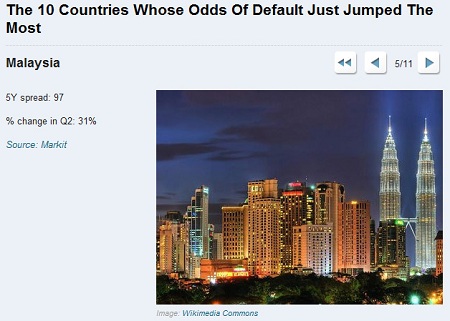
Odd of default....


I'm not an economist and hoping someone can tell me what is going on?
Stumble on this report here.

Time flies

Its been more than a year since the starting point....yet nothing move....soon!

What they say...

Silver