Showing posts with label value. Show all posts

Know your brokerage fee

Investing in shares must be done via brokerage, either you buy or sell, they take a cut irrespective of your gain or lose.

The big boys always had favourable fee structure from the brokerage house. It happen everywhere, in unit trust as well as share trading. Therefore, always go for the best rate.

Ask the brokerage with the high rates, what rate they give go the big boys?

Yes, you are the one that cross subsidized their profitability.

I am waiting for a fintech disruptor.....  

Kredit: redangpow.com

Be firm with telemarketers

THE Consumers’ Association of Penang would like to address the public on the issue of the telemarketing of insurance policies.

Based on the complaints we have received, we find that many consumers are caught in the trap of unknowingly purchasing insurance policies that are being promoted through telemarketing.

In light of these complaints, CAP took up the matter with Bank Negara Malaysia to say that we believe insurance companies should not be allowed to sell insurance policies through telemarketing because of the following reasons:

> Consumers are being pressured into agreeing to purchase insurance policies; advertisement

> Non-committal replies may be taken as a form of agreement; and

> Consumers do not receive their policies and therefore do not know that they are “covered”.

However, Bank Negara stated that the telemarketing of insurance policies is allowed and legal. Bank Negara also assured us through written correspondence that the telemarketing of insurance policies cannot be done on an “anything goes” basis. There are certain things that telemarketers and insurance companies must adhere to, including:

> A telemarketer while promoting the insurance policy must provide key information such as the product name, features, underwriting insurer, benefits and coverage, method of premium payment and consequences of non-payment;

> The telemarketer cannot assume that the consumer wants to purchase the product being sold. They must get the consumers’ express agreement before they can consider an insurance policy sold;

> The insurance company must send the consumer a copy of the Product Disclosure Sheet (PDS) together with the policy contract for insurance products (insurance policy); and

> There is a 15-day “free look” period after the delivery of the policy to return the policy to the insurance company (reject the policy) and get a refund on the premium that has already been paid. (Alert the insurance company if your insurance policy does not arrive within the time stipulated by the telemarketer.)

Finally, we advise consumers to speak clearly during a conversation with a telemarketer. Since no written contract is needed for the sale of an insurance policy over the phone, the telemarketing conversation itself becomes the legally binding contract between you and the insurance company.

If a dispute arises between the two parties, the telemarketing conversation is what will be referred to.

If you do not want to purchase the insurance policy then say “No”. Be assertive.

S.M. MOHAMED IDRIS
President
Consumers Association of Penang


We had a share of the story as well. Pity the new generation YZ, they are sure will get caught by this "bad" marketers which ultimately wanted to push their product regardless of suitability and need.
Hint: A good product need no sales people, user will hunt them.


bad-insurance-provider

Are you a high networth individual?


Based on Securities Commission Malaysia's guidelines, a high networth individual is defined as:

An individual whose total net personal assets, or total net joint assets with his or her spouse, exceeds RM3 million or its equivalent in foreign currencies, excluding the value of the individual's primary residence.

An individual who has a gross annual income exceeding RM300,000 or its equivalent in foreign currencies per annum in the preceding 12 months.

An individual who, jointly with his or her spouse, has a gross annual income of RM400,000 or its equivalent in foreign currencies per annum in the preceding 12 months.

Source: www.sc.com.my

#ekkamaisimplelife

Drive or take the public transport?

Are you among five million people who get stuck in the Klang Valley traffic every day?

According to the World Bank’s 2015 Malaysia’s Economic Monitor report:

  • Jams in Greater Kuala Lumpur may be getting bigger;
  • Commuters wasted between 270 and 500 million man-hours in the Greater KL jams last year.
  • Cars used a possible 1.2 billion litres of fuel idling in traffic;
  • Lost hours and fuel for each person in Greater KL came to at least RM3,100 each year, more than the monthly local average salary (RM2,795); and
  • Total cost of traffic in Greater KL is estimated at 1.1% to 2.2% of GDP in 2014.

“This is a tangible economic cost, in the sense that this is equivalent to money that could otherwise be in the pockets of the people of Kuala Lumpur,” - Luis C. Blancas, World Bank senior transport specialist.

World Bank data now suggest they may have to spend a longer time on the road.

Transport costs here are also high, accounting for nearly 10% of all monthly household expenses. Much of this can be saved if people took public transport. Really? Lets see.

I use this journey as an example.

Travelling via LRT from Bukit Jalil to Hang Tuah station in the city used to cost RM1.90 before but now..... (sourced from: http://www.myrapid.com.my/jp/index.php)

One way LRT fare 

Wow that is RM1.30 (cashless, ie via rapidcard or T&Go card) more or a whopping 68% increase!

If two friends were to traveled to say Bukit Bintang n back, that is going to cost them RM12.80 for the total fare using the LRT.

Say they drive there, spend few hours and back. The return estimated distance is 29km.

One way driving distance
  
How much it gonna cost them for that distance? If they use a common car which has an average fuel consumption of 8litre/100km, That is 2.32 litres and if petrol cost RM1.90/litre, the fuel cost is RM4.41 only.

Yeah, the are other cost like car cost, route and toll charges, parking fee, travelling time, etc but those are variables which depends on individual preference. 

I bet most of us did not realised that current LRT fares are now unique (different price) from a station to station, not like before which adopt sector concept where a same fare for few station within specified sector of stations. 
It means that before, RM1.90 was the fare to disembark at any stations from Hang Tuah up to PWTC, not any more.

The flaw in the new LRT fare?  Source.

To Station: Hang Tuah-PlazaRakyat-Masjid Jamek
RM: 3.20 - 3.30 - 3.40

To Station: Bandaraya-Sultan Ismail-PWTC
RM: 3.10  - 3.20  -3.30  

What is the rationale here? What comes to mind is, profit maximisation or cross subsidy?

So there you have it. Decide for yourself if the statement "people save if they took public transport" applies now days. It was before, for me.


one up on wall street - peter lynch


favourable attributes of a company

1. It sound dull, ridiculous
dull name, less attention eg. 3 stooges

2. it does something dull
eg. manufacturing cork, bottle cap

3. it does something disagreeable
eg. deals with dirty sludge

4. it's a spin-off
eg. separation of companies into freestanding entity

5. institution don't own it & analyst don't own it

6. rumours abound: involve in toxic waste, mafia

7.something depressing about it
eg. funeral home

8. its a no growth industry
eg plastic fork/knife, boring, no competition

9.its got a niche
eg. rock pit, drug, drug companies

10. people have to keep buying it
eg. cigar, softdrink

11. its a user of technology
eg. use technology to cut cost

12. the insider are buyer
eg. workers buying its company share

13. the company is buying back its shares


comparing growth rate to PE ratio
eg. long term growth=x%
dividend yield=y%
PE ratio=z
factor=(x+y)/z
look for >= 2, 1.5=ok, less than 1=poor

evaluating the cash position
eg
cash+marketable securities=5.7+4.4=10.1b
long term debt=1.8b
cash position=10.1-1.8=8.3b
outstanding sh=500m
net cash/sh=8300/500=16.6 (ignore st debt)
say sh is trdg at 38, net buying is 21.4 (38-16.6)
if expected earning/sh=7
at 38/sh, PE=5.4 (38/7)
but at 21.4, PE=3.1

say other biz in the group is contributing earning of 1.6/sh and its PE its 10.
so, its value is 1.6x10=16, extracting 21.4-16=5.4

therefore the net buying of this share is only at 5.4 although we are purchasing it at  38.
these type of value may emerge at any time but definitely at when the whole market  is under distress, bad economic situation, share market plunging.

continue searching.....

Something technical


Break it away
As a rule of thumb, "high volume" for any given market is at least 25 percent above average for the past two weeks, and "low volume" is at least 25 percent below average.
  1. High volume confirms trends. If prices rise to a new peak and volume reaches a new high, then prices are likely to retest or exceed that peak.
  2. If the market falls to a new low and the volume reaches a new high, that bottom is likely to be retested or exceeded. A "climax bottom7' is almost always retested on low volume, offering an excellent buying opportunity.
  3. If volume shrinks while a trend continues, that trend is ripe for a reversal. The reverse is untrue.
Prices represent the consensus of value, while volume represents the emotions of market participants.

On or off balance?
On-Balance Volume often rises or falls before prices - it acts as a leading indicator.
A new high in OBV shows that bulls are powerful, bears are hurting, and prices are likely to rise. A new low in OBV shows that bears are powerful, bulls are hurting, and prices are likely to fall. When the pattern of OBV deviates from the pattern of prices, it shows that mass emotions are not in gear with mass consensus. A crowd is more likely to follow its heart than its mind. This is why changes in volume often precede changes in prices. When OBV rises or falls together with prices, the trend is confirmed.

If prices reach a new high and OBV reaches a new high, the uptrend is likely to continue.

  1. When OBV reaches a new high, it confirms the power of bulls, indicates that prices are likely to rise even higher, and gives a buy signal.
  2. OBV gives its strongest buy and sell signals when it diverges from prices. If prices rally, sell off, and then rise to a new high, but OBV rallies to a lower high, it creates a bearish divergence and gives a strong sell signal. If prices decline, rebound, and then fall to a new low, but OBV falls to a more shallow bottom, it traces a bullish divergence and gives a strong buy signal.
  3. When prices are in a trading range and OBV breaks out to a new high, it gives a buy signal. When prices are in a trading range and OBV breaks down and falls to a new low, it gives a signal to sell short.
Which way is the traffic?

The Directional System is unique in telling you when a major new trend is likely to begin. It signals when a new baby bull or baby bear is being born.

The relative position of Directional lines identifies trends. When the Positive Directional line is above the Negative Directional line, it shows that bullish traders dominate the market. When the Negative Directional line rises above the Positive Directional line, it shows that bearish traders are stronger. It pays to trade in the direction of the upper Directional line.
  1. The best time to be long is when both +DI13 and ADX are above -DI13 and ADX rises.
  2. When ADX declines, it shows that the market is becoming less directional.
  3. When ADX falls below both Directional lines, it identifies a flat, sleepy market. Do not use a trend-following system but start getting ready, because major trends emerge from such lulls.
  4. The single best signal of the Directional system comes after ADX falls below both Directional lines. The longer it stays there, the stronger the base for the next move. 

When ADX rallies from below both Directional lines, it shows that the market is waking up from a lull.

Add or deduct

It was designed as a leading indicator for stocks, the unique feature of Accumulation/Distribution (AD) is that it tracks the relationship between opening and closing prices, along with volume. If prices close higher than they opened, then bulls won the day and AD is positive. If prices close lower than they opened, then the bears won and AD is negative. If pricks close where they opened, then nobody won and A/D is zero. A running total of each day's AID creates acumulative Accumulation/Distribution indicator.
The best trading signals are given by divergences between AD and prices. 
  1. A bullish divergence occurs when prices fall to a new low but AD stops at a higher low than during its previous decline. It shows that market professionals are using the decline for buying, and a rally is coming.
  2. If prices rally to a new high but AID reaches a lower peak, it gives a signal of bearish divergence, sell.
Waiting for spring or autumn
  • Screen 1: Weekly macd-histogram rising.
  • Screen 2: Use oscillator to a daily chart, find declines during weekly uptrends.
  • Screen 3: Use the trailing buy-stop technique when the weekly trend is up and the daily oscillator is down(stocastic/william%?).
Trailing buy stop technique: Place a buy order one tick above the high of the previous day.
As soon as you buy, place a stop-loss order one tick below the low of the trade day or the previous day, whichever is lower. Limit is only 2%.
Ride till price goes below 13wma or weekly stocastic going down from overbought or negative SAR begin.

Weekly Trend-Daily Trend-Action-Order:
UP-Down-Go long-Trailing buy stop

Good luck! Thanks doc.

Reality Check: Lapuran Penganalisa Saham untuk siapa sebenarnya?

Sesiapa yang baru berada dalam pasaran saham selalu tertanya, nak ikut laluan mana satu, ikut FA-Analisa fundamental, atau TA-Analisa Teknikal. Dua-dua ada pro dan con masing-masing. Warren Buffet pun menang, Darryl Guppy pun menang, aku???

Tiada jawapan terus dalam hal ini. Paparan ini tercetus dari artikel INI dimana blogger ni dah buat analisa beliau dalam pasaran unit trust. Dia ada kaedah tersendiri dalam memilih tabungan dengan melakukan analisa berdasarkan prestasi.
Lalu saya ambil kaedah yang sama dan melihat dari sudut pasaran saham pula kerana pada saya "lapuran penganalisa ini bersepah" dan siapa-siapa pun boleh dapatkannya. Dari lapuran ini, yang ketara adalah cadangan ataupun syor untuk beli atau jual.

Jadi untuk tujuan mencari jawapan ini, saya gunakan lapuran dari sebuah institusi yang besar dirantau asia ini (lapuran ini lebih 300 mukasurat, bak kata orang - koprehensif). Mereka-mereka yang
menulis lapuran ini adalah kebanyakannya adalah lulusan professional dalam bidang analisa ini.

Jawapan yang saya cari ialah: Adakah lapuran penganalisa ini untuk saya?

analisa-saham
Ringkasan penilaian


Data dalam rigkasan diatas adalah berikut:
1. ID - nombor pengenalan data
2. Pr@8Dec14 -Harga pada tarikh berkenaan
3. Tgt - Target Harga
4. %UpDn - Peratusan kenaian atau penurunan
5. Recom - Cadangan/Syor penganalisa
6. Prdict  - Tukar Reduce=0, Hold=1, Add=2*
7. Pr@Dec - Harga pada akhir Dec14
8. Pr@Sep15 - Harga pada akhir Sep15
9. PrCheck  - Ruang untuk memeriksa harga adalah munasabah^^
10.PrSepVsTgt - Harga Sep15 tolak Harga Target
11.VsTgt - Lose=kalah, Better=Menang**
12.Actual  - Tukar Lose=10, Better=11*

* Dua kolum ini adalah representasi untuk plot graf sahaja.
^^ Didapati ada satu data mengalami split/pecahan nilai
**  Lose=Harga Sept dibawah Target, Menang=Harga Sept melebihi Target Harga

Seksyen berwarna sebelah kiri adalah cabutan dari lapuran penganalisa dan seksyen sebelah kanan adalah analisa saya untuk menentukan jawapan yang saya cari.


Di akhir lapuran penganalisa ada definasi berikut:-

Stock Ratings Definition:
Add: The stock’s total return is expected to exceed 10% over the next 12 months.
Hold: The stock’s total return is expected to be between 0% and positive 10% over the next 12 months.
Reduce: The stock’s total return is expected to fall below 0% or more over the next 12 months.


Ya jangkamasa 12 bulan tu ada ~ dua bulan lagi, jadi analisa ni terkurang 2 bulan lah.
Tak mengapa kerana saya bukan memerlukan jawapan tepat seperti saintis loji nuklear - saya hanya ingin buat validasi adakah lapuran penganalisa saham untuk kita?

Klik imej untuk besarkan

Dari plot graf diatas saya dah dapat jawapan. Lapuran tersebut bukan untuk orang seperti saya. Anda yang masih ingin kepastian, boleh download fail pdf tersebut dan mulakan kajian sendiri. Ini adalah kajian/pandangan saya untuk menang dalam pasaran - anda bebas menilai!

Jadi saya akan lebih berhati-hatilah selepas ini apabila anda membaca Lapuran Penganalisa Saham kerana saya dah yakin rata-rata lapuran ini bukan untuk saya. Untuk siapa? Masih tiada jawapan.

Mungkin selepas ini saya tulis pula bila lapuran mereka boleh diambil kira.....

TOP WARNING SIGNALS FOR COMPANY TO GO BANKRUPT


bankrupt-signals

Article by Dr. Nazri Khan first appeared in Mac 2014.

Transmile, Kenmark, Megan Media, Ekran, Linear Corp, Scan Associates, Golden Plus, Dis Technology, Welli Multi and of course Renong Berhad. All are distressed public listed companies which have disappeared.

Will Malaysia Airlines join them ? Good question. Maybe and maybe not.

My sixteen years experience shows that companies rarely go into bankruptcy without some warning. The following are the BEST TOP WARNING SIGNALS which will tell us 99% they are going under. Beware & Stay Away.

xxxxxxxxxxxxxxxxxxxxxxxxxxxxxxxxxxx

Danger Sign No. 1
Management Scandal. Leaders keep changing.
A serious warning if top guys CEO or CFO take flight suddenly without explanation or give stupid reason such as personal commitement or personal health reason.

Danger Sign No. 2 
A History of Financial Restatements or Late Filings.
Late financial reporting and accounting restatements normally are associated with bad management integity. This was especially characteristic of companies engaging in complex accounting to sweep losses under the rugs and hide liabilities just to drive stock prices higher.

Danger Sign No. 3 
Faster Growth in Accounts Receivable With Flat Growth of Sales.
Faster growth of receivables than growth of sales. The balance sheet is full of rubbish sales with no cash to accrue. Bad companies have serious bad debts, rising receivables and credit downgrade.

Danger Sign No. 4 
Mysterious Growth In Inventories.
Unexpected bumps in inventories relative to sales. Growing inventories could signal a weak customer base, or worse, that the company use suspicious creative accounting to boost value of inventories to offset declining sales.

Danger Sign No. 5 
Mysteriously Bad Cash Flow With Strong Profits And Sales.
Cash flows is the most transparent and is extremely difficult for management to abuse. Bad cash flow normally suggest complex liquidity and smells trouble for the company. If net income is increasing at a faster clip than cash flow, beware. If earnings are rising year to year and cash flow is not, danger! Either way, something’s not right.

Danger Sign No. 6 
Frequent Change Bank Lender And Swim With Loan Sharks.
A company's relationship with its bank and any changes therein is also a useful financial signal. Reduced availability on a company credit line or a frequent change in borrowing patterns may be indicative of financial problems. Increase in loan security and unsecured loan from no-brand-lender are clear evidence of deterioration in the financial health of a business. Finally, the breaching of loan covenants or missed loan payments are clear warning signs that the company requires help.

Danger Sign No. 7 
Three Years Combo Of Sustain Operational Losses And Decline In Sales.
A sustained decline in sales, poor profit margins, losses, increased debt, a highly leveraged balance sheet and negative working capital over twelve straight quarters may be the best cancer signals of a serious financial distress.

Danger Sign No 8 
A Series Of Bad Lucks In A Row
Companies face so many highly improbabale one-time events back-to-back such as a warranty claim, the cancellation of a large order, a huge union strike, an adhoc special operational audit, a sudden uninsured fire or theft, a sudden departure of supplier or a serious change in supplier payments. A failure to explain this event may be some creative accounting management is using to cover operational losses.

xxxxxxxxxxxxxxxxxx

Hall Of Fame :
1. Transmile Group Berhad
Recorded a net loss of RM369.56 million and overstated its consolidated revenues by RM 530 million in 2005 after a special audit was conducted.

2. Kenmark Industrial Berhad
Fail to issue the fourth-quarter results 2010 for three months. Operations stopped while two banks demanded RM73 million. Became a PN17 company and shares tumbled 80 per cent.

3. Megan Media Holdings Berhad
Posted a mind-boggling net loss of RM1.14 billion for the fourth quarter ended April 30, 2007. Investigated by the Securities Commission, and found to have defaulted RM893.97mil in maturing banking facilities.

4. Ekran Berhad
Magnificent rise in 1990s corporate Malaysia but only to hit a peak months after it had been awarded the contract for the multi-billion ringgit Bakun hydroelectric dam project. Defaulted loan payments and was categorised as a PN1 and PN17 company for at least four years before delisted from Bursa Malaysia.

5. Linear Corp Berhad
A cooling systems company that has landed itself into a PN17 company after being investigated by Bursa Malaysia and the Securities Commission over its troubled RM1.6bil King Dome project in Manjung, Perak.

6. SCAN Associates Berhad
The board of directors lodged a police report and then dismissed CEO following an alleged misappropriation of near RM2 million funds.

7. Golden Plus Holdings Berhad
Failed to submit its audited accounts and annual report for 2007 and its quarterly report for the period ended March 2008 before being reprimanded by SC.

8. DIS Technology Holdings Berhad
Found to misstate several quarterly reports due to an alleged employee fraud worth RM80 mil reported by a major customer based in Hong Kong.

9. WELLI Multi Corp Berhad
Managing director were convicted for furnishing the Securities Commission with misleading fictitious sales information of RM141 million in its audited 2005 financial statement.

10. Renong Berhad
The deal involving United Engineers (M) Bhd’s (UEM) mysterious put option with a total cost of RM2.34bil from an unknown sellers which later expired with no settlement. The CEO later resigned from the group in October 2001 and later sues government for a sour business deal.

My dedication to all investors of these companies. Hope we learn something.

What happened to MAS?

Saham amanah terbaik untuk pelabur KWSP

Rekod unit saham amanah yang telah menunjukkan prestasi terbaik antara 2009 sehingga 2013. Pastikan anda tidak terlepas pandang mereka-mereka ini sekiranya pulangan yang terbaik adalah matlamat pelaburan anda. Biar dalam KWSP pon boleh juga, pulangan 5-6% je setahun. 

Mengikut "Rule of 72" jika pulangan purata ialah 20%, pelaburan anda akan berganda setiap 3.6 tahun!

Rule of 72: Gandaan pelaburan(tahun) = 72/peratus pulangan tahunan

pulangan-saham-amanah-terbaik

saham-amanah-terbaik-2013
Terbaik pada tahun 2013

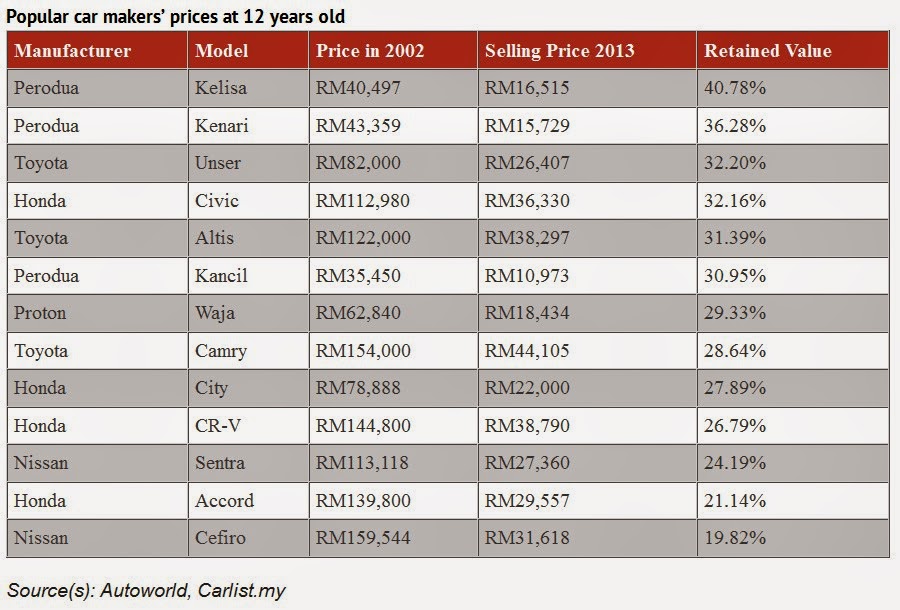
Cars and its value

valuable-malaysian-cars

Surely this picture worth a thousand words. I'm not surprise to see the top two model because I personally knew a team member who was developing the model!

Cars - a negative equity assets, yet loved by many!

Things you should not buy new

1. DVDs and CDs: Used DVDs and CDs will play like new if they were well taken care of. Even if you wind up with a scratched disc and you don't want to bother with a return, there are ways to remove the scratches and make the DVD or CD playable again.
2. Books: You can buy used books at significant discounts from online sellers and brick-and-mortar used book stores. The condition of the books may vary, but they usually range from good to like-new. And of course, check out your local library for free reading material.
3. Video Games: Kids get tired of video games rather quickly. You can easily find used video games from online sellers at sites like Amazon and eBay a few months after the release date. Most video game store outlets will feature a used game shelf, as well. And if you're not the patient type, you can rent or borrow from a friend first to see if it's worth the purchase.
4. Special Occasion and Holiday Clothing: Sometimes you'll need to buy formal clothing for special occasions, such as weddings or prom. Most people will take good care of formal clothing but will only wear it once or twice. Their closet castouts are your savings: Thrift stores, yard sales, online sellers and even some dress shops offer fantastic buys on used formalwear.
5. Jewelry: Depreciation hits hard when you try to sell used jewelry, but as a buyer you can take advantage of the markdown to save a bundle. This is especially true for diamonds, which has ridiculously low resale value. Check out estate sales and reputable pawn shops to find great deals on unique pieces. Even if you decide to resell the jewelry later, the depreciation won't hurt as much.
6. Ikea Furniture: Why bother assembling your own when you can pick it up for free (or nearly free) on Craigslist and Freecycle? Summer is the best time to hunt for Ikea furniture--that's when college students are changing apartments and tossing out their goodies.
7. Games and Toys: How long do games and toys remain your child's favorite before they're left forgotten under the bed or in the closet? You can find used children's toys in great condition at moving sales or on Craigslist, or you can ask your neighbors, friends, and family to trade used toys. Just make sure to give them a good wash before letting junior play.
8. Maternity and Baby Clothes: Compared to everyday outfits that you can wear any time, maternity clothes don't get much wear outside the few months of pregnancy when they fit. The same goes for baby clothes that are quickly outgrown. You'll save a small fortune by purchasing gently used maternity clothes and baby clothes at yard sales and thrift stores. Like children's games and toys, friends and family may have baby or maternity clothing that they'll be happy to let you take off their hands.
9. Musical Instruments: Purchasing new musical instruments for a beginner musician is rarely a good idea. (Are you ready to pay $60 an hour for piano lessons?) For your little dear who wants to learn to play an instrument, you should see how long his or her interest lasts by acquiring a rented or used instrument to practice with first. Unless you're a professional musician or your junior prodigy is seriously committed to music, a brand new instrument may not be the best investment.
10. Pets: If you buy a puppy (or kitty) from a professional breeder or a pet store outlet, it can set you back anywhere from a few hundred dollars to several thousand dollars. On top of this, you'll need to anticipate additional fees and vet bills, too. Instead, adopt a pre-owned pet from your local animal shelter and get a new family member, fees, and vaccines at a substantially lower cost.
Sourced from Yahoo Finance

Bank oh Banks

Ask any bank about their service, what they can give you and you'll get the feeling they are the best. Gee I got to tell you this....

Last week, on a weekday, I put my worn out jeans, t shirt and wear a slipper and started to walk around to find out who would be able to provide the best deal for my 300K home refinancing. When I bought this property, my god the banks are all out to win my heart to take their loan. But this time the experience, is totally different.

I walk into 3 foreign based bank (a standard one, cap payung and the rajin kut) and 3 local banks. Local bank as usual la, customer focused mentality is non existence. Sorry guys, I like to keep the money circulating in the country but who cares...

Of the three, the rajin is the one that stand out, immediately as I walk in someone is there to ask how could they help me. Wow.
At the standard one, I walk in slowly passing those nice working cubicles towards the counter at the end, no one care to ask. I pause, waiting and then I thought a nice environment is actually useless if the simple customer service is non existance. The one who really notice me, I guess is the armed security guard. Maybe I look like robbers kut!

Yeah from now on, I don't have preference for any bank brand. Go on you guy can spend million on air to say you do smile, great service, but today I proved to myself, it is all bluff.

My advice to the young people, if you need a loan press hard the staff for the best deal and ask them to compete and may the best win your account. Dont listen to their intimidation saying that you may not qualify.
After all, in any loan, the deal may take few weeks to settle and then you are expected to diligently pay them every month, aka work for the banks. Guess when do you hear from them again? Try to miss a few month repayment, I'm sure they want to talk to you again after so long...

What they say...

Silver